
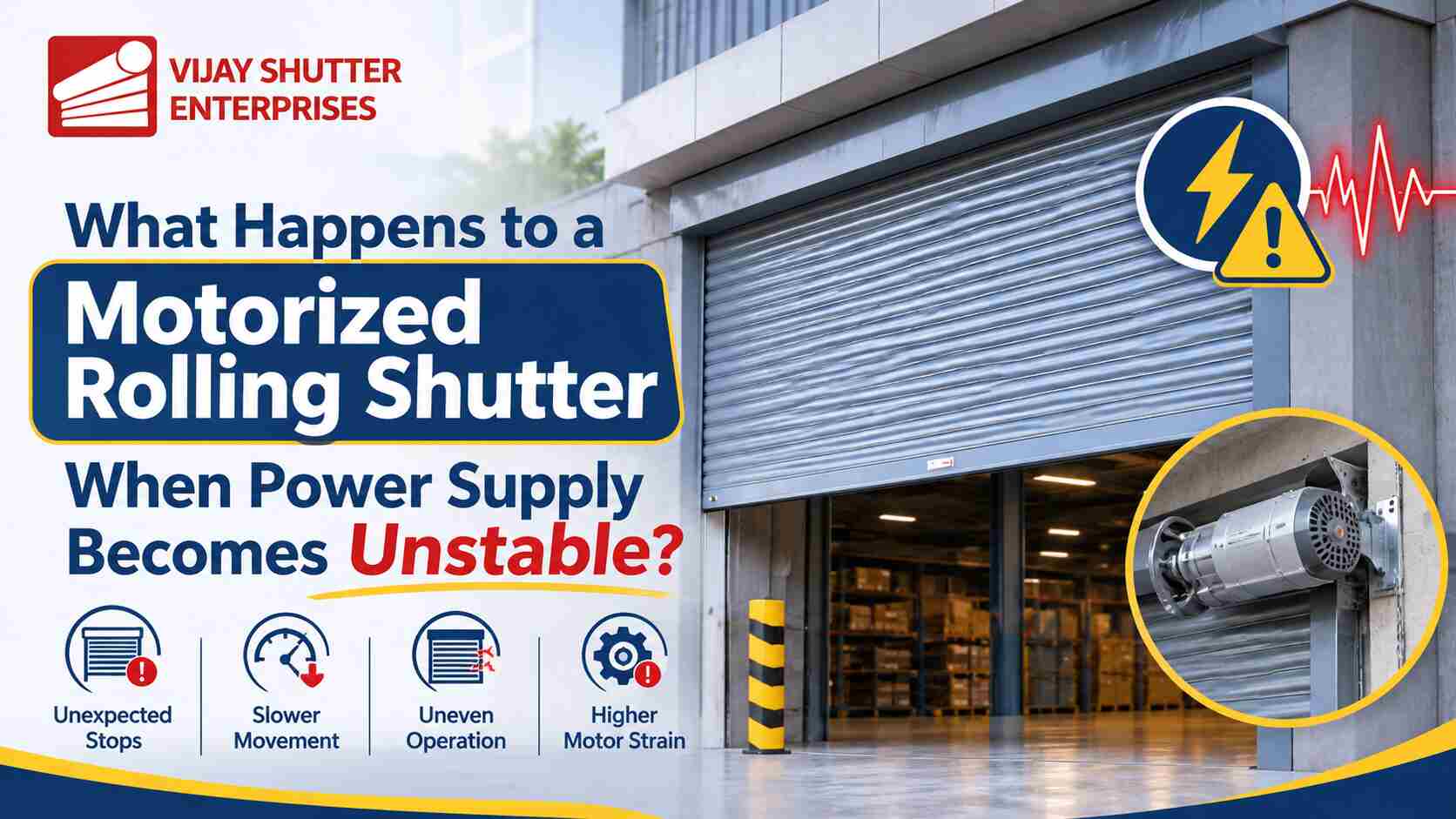
What Happens to a Motorized Rolling Shutter When Power Supply Becomes Unstable?
HBS-login2026-11-19T07:11:29+00:00Have you ever wondered what happens when a shutter loses power while opening or closing? Can voltage fluctuations affect its motor, and will it work normally once electricity returns? These are common concerns for shop owners, warehouse operators and industrial property managers. At Vijay Shutter Enterprises, we understand that dependable operation relies on the electrical supply, control system and moving components working together. Therefore, knowing how a Motorized rolling shutter responds to unstable electricity can help property owners recognise problems, plan backup arrangements and avoid unsafe attempts to operate the shutter.
How Does a Motorized Rolling Shutter Depend on a Stable Power Supply?
An electric shutter motor receives power through an electrical control panel and turns a drive mechanism connected to the shutter shaft or drum assembly. When someone presses a remote control or wall-mounted switch, the motor rotates in the required direction. As a result, the curtain moves along the guide channels. Limit switches help stop it at the selected opening and closing positions.
However, this process depends on a suitable electrical supply. If the voltage moves outside the motor’s specified range, operation may become irregular or a protection feature may stop the motor. The exact response depends on the motor type and its control arrangement.
How Voltage Fluctuations Affect Rolling Shutter Motor Performance
An electrical motor may be affected by variations in voltage due to insufficient or excessive supply levels. Insufficient supply levels, for instance, may limit the ability of the motor to function well or start up in certain situations. It may also result in overheating of the motor. An excessively high voltage or a power surge may damage electrical components beyond their rating level.
Fluctuations in the voltage levels may also have an impact on the motor control unit, capacitor, and the connections of the wiring. Therefore, running the motor under such unsuitable conditions may lead to decreased performance. A suitable voltage regulator or surge protector may be required in order to handle certain risks.
What Happens During a Rolling Shutter Power Failure?
A rolling shutter power failure may happen while the curtain is moving or when it is fully open or closed. If electricity stops during movement, the motor generally stops receiving power. The shutter may remain in place if its braking and holding arrangement is designed to do so. Nevertheless, its response depends on the motor, electromagnetic brake and safety configuration.
For instance, a shop shutter that stops halfway may leave the entrance partly exposed. Therefore, avoid pulling, pushing or forcing the curtain, as this can damage the motor gearbox, shaft or other components. Once power returns, check whether the shutter operates normally. If it moves unevenly, makes unusual sounds or does not respond, arrange an inspection rather than repeatedly pressing the switch.
Can Rolling Shutter Backup Power Prevent Interruptions?
A suitable rolling shutter backup power arrangement can allow operation when the main supply is unavailable. However, it must match the installed motor’s electrical requirements. Options may include a battery backup system, a correctly rated Uninterruptible Power Supply (UPS) or another manufacturer-approved emergency power supply.
Before choosing battery backup for rolling shutters, consider the motor rating, curtain weight, number of operating cycles, available space and required backup duration. In larger premises, a backup generator may also be considered, particularly when several systems need power. In every case, the installer should confirm compatibility and safe connection. This is particularly important when a Motorized rolling shutter is expected to operate during frequent power interruptions.
How Does a Manual Override Mechanism Help During Power Cuts?
Some motors include a manual override mechanism for operating the shutter when electricity is unavailable. Depending on the model, it may use a hand chain, crank or dedicated emergency release mechanism. However, not every installation includes this feature.
It is important to ask your installers how to use this facility and where the location of the manual release is. Never try to manually lift the shutter without knowing about the system. We at Vijay Shutter Enterprises advise people to know about the motor setup and the emergency provisions of the shutter.
Businesses comparing options can also speak with experienced automatic rolling shutter manufacturers about motor compatibility, electrical requirements and available emergency features.
Practical Ways to Protect Shutter Motors
Although power problems cannot always be prevented, a few precautions can reduce avoidable interruptions:
- Check the supply: Ensure that voltage and current meet the motor manufacturer’s requirements.
- Use suitable protection: A qualified electrician can advise on compatible circuit breakers, surge protection and voltage management.
- Avoid repeated switching: If the shutter does not respond, do not keep pressing the remote or wall switch.
- Follow the duty cycle: Allow the motor to cool as recommended to reduce the risk of overheating.
- Inspect connections: Have loose wiring, damaged insulation and poor connections checked by a qualified electrician.
- Maintain moving parts: Keep guide channels clear and check the curtain, drum assembly and drive mechanism for wear.
In addition, make sure authorised users know how to use the emergency controls, if fitted.
When Should You Arrange a Motor Inspection?
If the motor frequently trips out, overheats, produces any unfamiliar sounds, or does not start again following the restoration of the power supply, then you should call for a professional examination. In addition, any problems with the movement of the curtains, their positioning, faulty wires, or the tripping of the overload relay must also be taken into consideration.
The technician will examine the capacitor, gearbox, electromechanical brake, limit switches, and electrical control panel. Once the problem is diagnosed, they will advise how to fix the situation.
Conclusion: Plan for Reliable Shutter Operation
Power interruptions cannot always be avoided. However, a suitable motor, correct electrical protection and a clear emergency plan can make them easier to manage. Regular checks also help identify problems before they interrupt daily work.
At Vijay Shutter Enterprises, we understand that each property has different shutter requirements. We focus on sturdy shutter solutions designed for smooth, dependable everyday use.
Visit Vijay Shutter Enterprises on Google Business Profile to learn more about our business and shutter solutions. Contact us to discuss a suitable shutter arrangement for your commercial, industrial or residential property.
Frequently Asked Questions
Yes, but only if the shutter is designed to function using an appropriate backup power source or manually. Otherwise, the shutter will normally not be operable until power resumes.
It could. Low voltage might cause the motor to struggle starting up, draw excessive current or overheat. This should be investigated if such an issue persists.
I should not attempt to force it. People should keep away from the aperture, follow the manufacturer’s protocol for emergencies, if any, and seek help from a professional if the shutter cannot be made secure.
Not necessarily. The battery backup system is an extra option that many use. I need to consider the compatibility of the motor and its operational capacity while making my selection.
It could be due to a tripped circuit breaker, motor protection activation, a loose connection, or a defect in the control unit. Hence, an inspection is the best course of action.






Leave a Reply